
Fastening Solutions: 24/7 – Always Ready to Power Your Industrial Needs

Fastening Solutions: 24/7 – Always Ready to Power Your Industrial Needs
Fastening Solutions: 24/7 – Always Ready to Power Your Industrial Needs
Fastening Solutions: 24/7 – Always Ready to Power Your Industrial Needs

Accurate bolt weight data is foundational to structural engineering, procurement planning, and logistics management. Whether you are ordering fasteners in bulk, calculating dead loads for a steel structure, or shipping components across continents, a reliable bolt weight chart eliminates guesswork and reduces costly errors.
This page serves as a complete engineering reference hub covering hex bolt weight, anchor bolt weight, nut bolt weight charts in KG, downloadable PDF resources, bolt dimensions, grade classifications, and online calculator guidance. All values are based on widely recognized international standards including ISO and DIN specifications, covering mild steel (MS) and stainless steel (SS) fasteners.
Engineers, procurement managers, structural contractors, and manufacturing teams will find everything needed here — from individual piece weights to weight per 100 bolts, from M6 to M48 metric sizes, and from standard hex bolts to J-type anchor bolts. Bookmark this page as your go-to fastener reference.
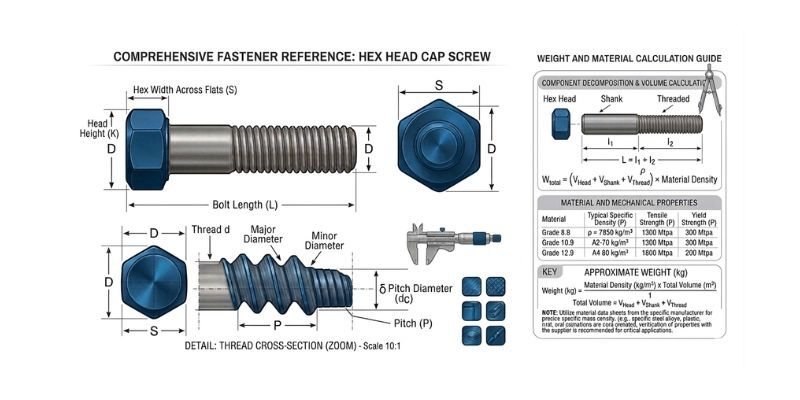
Bolt weight is influenced by diameter, length, thread type, head style, and material density. The tables below provide commercial standard approximate weights for mild steel hex bolts (density 7.85 g/cm³) across common lengths.
| Length (mm) | M6 | M8 | M10 | M12 | M16 | M20 | M24 |
|---|---|---|---|---|---|---|---|
| 20 | 4.0 | 7.1 | 11.0 | 16.0 | 28.0 | 43.0 | 62.0 |
| 30 | 5.6 | 10.0 | 16.5 | 23.5 | 40.0 | 61.0 | 88.0 |
| 40 | 7.2 | 12.8 | 21.8 | 31.0 | 52.0 | 79.0 | 113 |
| 50 | 8.8 | 15.6 | 27.0 | 38.5 | 64.0 | 96.0 | 138 |
| 60 | 10.4 | 18.4 | 32.3 | 46.0 | 76.0 | 114 | 163 |
| 70 | 12.0 | 21.2 | 37.5 | 53.5 | 88.0 | 132 | 188 |
| 80 | 13.6 | 24.0 | 42.8 | 61.0 | 100 | 150 | 213 |
| 100 | 16.8 | 29.6 | 53.3 | 76.0 | 124 | 186 | 263 |
| 125 | 20.8 | 36.5 | 66.5 | 94.5 | 155 | 232 | 328 |
| 150 | 24.8 | 43.5 | 79.8 | 113 | 186 | 278 | 393 |
| 200 | 32.8 | 57.3 | 106.3 | 150 | 248 | 370 | 523 |
The dimensional tolerances for hex bolts are standardized under ISO 4014 (partially threaded) and ISO 4017 (fully threaded). Key dimensions include:
| Bolt Size | Shank Dia. d (mm) | Width Across Flats s (mm) | Head Height k (mm) | Thread Pitch (mm) | Thread Length b (mm) |
|---|---|---|---|---|---|
| M6 | 6.0 | 10 | 4.0 | 1.0 | 18 |
| M8 | 8.0 | 13 | 5.3 | 1.25 | 22 |
| M10 | 10.0 | 17 | 6.4 | 1.5 | 26 |
| M12 | 12.0 | 19 | 7.5 | 1.75 | 30 |
| M16 | 16.0 | 24 | 10.0 | 2.0 | 38 |
| M20 | 20.0 | 30 | 12.5 | 2.5 | 46 |
| M24 | 24.0 | 36 | 15.0 | 3.0 | 54 |
| M30 | 30.0 | 46 | 18.7 | 3.5 | 66 |
| M36 | 36.0 | 55 | 22.5 | 4.0 | 78 |
| M42 | 42.0 | 65 | 26.0 | 4.5 | 90 |
| M48 | 48.0 | 75 | 30.0 | 5.0 | 102 |
The bolt head size — specifically width across flats (WAF) — determines the spanner or socket size required during installation. WAF is standardized per ISO 272.
| Bolt Size | WAF – Width Across Flats (mm) | Width Across Corners (mm) | Spanner Size (mm) |
|---|---|---|---|
| M6 | 10 | 11.5 | 10 |
| M8 | 13 | 15.0 | 13 |
| M10 | 17 | 19.6 | 17 |
| M12 | 19 | 21.9 | 19 |
| M16 | 24 | 27.7 | 24 |
| M20 | 30 | 34.6 | 30 |
| M24 | 36 | 41.6 | 36 |
| M30 | 46 | 53.1 | 46 |
| M36 | 55 | 63.5 | 55 |
Thread pitch is the distance in millimeters between adjacent thread crests. Metric bolts use coarse thread pitch as standard (e.g., M20 = 2.5mm pitch) with fine pitch available for vibration-prone applications.
Shank length refers to the unthreaded cylindrical portion of the bolt body. For partially threaded bolts (ISO 4014), shank length = total length minus thread length (b). Fully threaded bolts (ISO 4017) have no unthreaded shank; thread runs the entire body length.
In structural bolted connections, shank length placement within the grip zone affects joint shear performance and must be specified correctly in bolt schedules.
Hex bolts, also called hexagonal head bolts, are the most widely used structural fasteners in construction and mechanical assemblies. Their weight varies based on nominal diameter, length, thread pitch, and material density. The values below are calculated for mild steel (density: 7.85 g/cm³) per ISO 4014 (partially threaded) and ISO 4017 (fully threaded) standards.
Understanding weight per piece and weight per 100 pieces helps procurement teams accurately plan shipment loads, verify invoice quantities, and calculate structural dead loads.
| Size | Length (mm) | Weight/Piece (kg) | Weight/100 Pcs (kg) | Grade |
|---|---|---|---|---|
| M6 | 20 | 0.004 | 0.40 | 8.8 |
| M6 | 30 | 0.005 | 0.50 | 8.8 |
| M8 | 20 | 0.007 | 0.70 | 8.8 |
| M8 | 30 | 0.009 | 0.90 | 8.8 |
| M8 | 50 | 0.013 | 1.30 | 8.8 |
| M10 | 30 | 0.016 | 1.60 | 8.8 |
| M10 | 50 | 0.022 | 2.20 | 8.8 |
| M10 | 75 | 0.031 | 3.10 | 8.8 |
| M12 | 30 | 0.026 | 2.60 | 8.8 |
| M12 | 50 | 0.036 | 3.60 | 8.8 |
| M12 | 75 | 0.050 | 5.00 | 8.8 |
| M12 | 100 | 0.065 | 6.50 | 8.8 |
| M16 | 40 | 0.065 | 6.50 | 8.8 |
| M16 | 60 | 0.089 | 8.90 | 8.8 |
| M16 | 80 | 0.113 | 11.30 | 8.8 |
| M16 | 100 | 0.137 | 13.70 | 8.8 |
| M20 | 50 | 0.134 | 13.40 | 8.8 |
| M20 | 70 | 0.175 | 17.50 | 8.8 |
| M20 | 100 | 0.231 | 23.10 | 8.8 |
| M20 | 150 | 0.318 | 31.80 | 8.8 |
| M24 | 60 | 0.239 | 23.90 | 8.8 |
| M24 | 80 | 0.298 | 29.80 | 8.8 |
| M24 | 100 | 0.357 | 35.70 | 8.8 |
| M24 | 150 | 0.505 | 50.50 | 8.8 |
Note: For grade 10.9 bolts, multiply values by approximately 1.01–1.02 (negligible density difference; same geometry). Stainless steel 316 bolts weigh approximately 1–2% more due to slightly higher density (8.0 g/cm³).
Anchor bolts are used to attach structural elements to concrete foundations. They appear in column base plates, equipment mounting, bridge structures, and seismic retrofitting. Common anchor bolt types include L-type (bent), J-type (hook end), headed (plate washer), and double-end threaded rods.
Anchor bolt weight depends on the rod diameter, total length including the embedded hook or bend, and material. The following anchor bolt weight chart table covers common foundation bolt sizes used in structural and civil engineering.
| Diameter (mm) | Total Length (mm) | Threaded Length (mm) | Weight/Piece (kg) | Weight/100 Pcs (kg) |
|---|---|---|---|---|
| M12 | 300 | 100 | 0.26 | 26.0 |
| M16 | 400 | 150 | 0.53 | 53.0 |
| M20 | 500 | 200 | 0.97 | 97.0 |
| M24 | 600 | 200 | 1.60 | 160.0 |
| M30 | 700 | 250 | 3.05 | 305.0 |
| M36 | 800 | 300 | 5.07 | 507.0 |
| M42 | 1000 | 350 | 9.27 | 927.0 |
| M48 | 1200 | 400 | 14.89 | 1489.0 |
Anchor bolts in standard sizes follow IS 5624:2021 specifications for foundation bolts used in civil engineering, defining shank forms like J-type and L-type hooks, thread dimensions, and preferred embedment lengths. These dimensions ensure proper anchorage in concrete while accommodating tolerances for hook radius (±3mm) and nut compatibility
| Thread Size | Hook Radius 'a' (±3) | Hook Depth 'b' (A/B Forms) | Nut Width 'e' Max | Hook Width 'c' Max |
|---|---|---|---|---|
| M12 | 36 | 45 (B) | 55 | 30 |
| M16 | 48 | 55 | 70 | 40 |
| M20 | 60 | 70 | 85 | 50 |
| M24 | 75 | 90 | 100 | 60 |
| M30 | 95 | 115 | 130 | 75 |
| M36 | 115 | 135 | 160 | 90 |
| M42 | 135 | 155 | 185 | 105 |
| M48 | 155 | 180 | 210 | 120 |
Anchor bolt dimensions are defined by five primary parameters:
Engineers select anchor bolt sizes based on tensile load requirements, concrete strength (fck), and edge distance calculations per IS 456, ACI 318, or Eurocode 2.
| Diameter (mm) | Total Length (L, mm) | Threaded Length (b, mm) | Hook Length (mm) | Projection (mm) |
|---|---|---|---|---|
| M12 | 300 | 100 | 45 | 50 |
| M16 | 400 | 150 | 55 | 60 |
| M20 | 500 | 200 | 70 | 70 |
| M24 | 600 | 200 | 90 | 80 |
| M30 | 700 | 250 | 115 | 100 |
| M36 | 800 | 300 | 135 | 120 |
| M42 | 1000 | 350 | 155 | 150 |
| M48 | 1200 | 400 | 180 | 180 |
When calculating total fastener assembly weight, the combined weight of the bolt and matching nut must be accounted for. This is particularly important in structural steel fabrication, flange joint assemblies, and offshore platform design where total load calculations are mandatory.
| Nut Size | Width Across Flats (s, mm) | Thickness (m, mm) | Weight/Piece (kg) | Weight/100 Pcs (kg) | Weight/1000 Pcs (kg) |
|---|---|---|---|---|---|
| M6 | 10 | 5.0 | 0.0025 | 0.25 | 2.50 |
| M8 | 13 | 6.5 | 0.0052 | 0.52 | 5.20 |
| M10 | 17 | 8.0 | 0.0116 | 1.16 | 11.60 |
| M12 | 19 | 10.0 | 0.0173 | 1.73 | 17.30 |
| M16 | 24 | 13.0 | 0.0333 | 3.33 | 33.30 |
| M20 | 30 | 16.0 | 0.0644 | 6.44 | 64.40 |
| M24 | 36 | 19.0 | 0.1100 | 11.00 | 110.00 |
| M30 | 46 | 24.0 | 0.2250 | 22.50 | 225.00 |
| M36 | 55 | 29.0 | 0.3750 | 37.50 | 375.00 |
| Size | Bolt Wt/Piece (kg) | Nut Wt/Piece (kg) | Total/Piece (kg) | Total/100 Pcs (kg) |
|---|---|---|---|---|
| M10 | 0.062 | 0.0116 | 0.0736 | 7.36 |
| M12 | 0.089 | 0.0173 | 0.1063 | 10.63 |
| M16 | 0.158 | 0.0333 | 0.1913 | 19.13 |
| M20 | 0.246 | 0.0644 | 0.3104 | 31.04 |
| M24 | 0.355 | 0.1100 | 0.4650 | 46.50 |
A downloadable nut bolt weight chart in kg PDF covering M4 through M48 sizes is available at the end of this page. It includes washer weights and high-tensile grades 8.8, 10.9, and 12.9.
The Weight Calculation Formula
Bolt weight is calculated using the standard volumetric formula:
Weight (kg) = Volume (cm³) × Density (g/cm³) ÷ 1000
A simplified formula commonly used in engineering estimation:
Weight (kg) = (π/4) × d² × L × ρ × 10⁻⁶
Where:
This aligns with tabulated values of 0.231–0.318 kg/piece for M20 × 100mm bolts, with minor variation due to chamfers, thread relief, and manufacturing tolerances.
| Material | Grade/Type | Density (g/cm³) |
|---|---|---|
| Mild Steel (MS) | 4.6, 8.8, 10.9 | 7.85 |
| Alloy Steel | 10.9, 12.9 | 7.87 |
| Stainless Steel | SS 304 | 7.93 |
| Stainless Steel | SS 316 | 8.00 |
| Brass | — | 8.50 |
| Aluminum Alloy | — | 2.70 |
Online hex bolt weight calculators use these density values combined with exact geometric inputs to produce precise per-piece and per-lot weights. For high-value procurement or structural analysis, always verify calculated weights against certified mill test reports (MTRs).
Bolt property class (commonly called "grade" in industry) defines the mechanical strength of a fastener. ISO 898-1 governs property classes for metric steel bolts. The marking system uses a two-number code separated by a decimal: the first number × 100 = minimum tensile strength (MPa), and the product of both numbers × 10 = minimum yield strength (MPa).
| Property Class | Min. Tensile Strength (MPa) | Min. Yield Strength (MPa) | Proof Load Stress (MPa) | Hardness (HRB/HRC) | Typical Application |
|---|---|---|---|---|---|
| 4.6 | 400 | 240 | 225 | 67–95 HRB | Light structural, general purpose |
| 5.6 | 500 | 300 | 280 | 79–95 HRB | Medium structural |
| 6.8 | 600 | 480 | 440 | 89–95 HRB | Machine components |
| 8.8 | 800 | 640 | 580 | 22–32 HRC | Structural steel, bridges |
| 10.9 | 1000 | 900 | 830 | 32–39 HRC | High-strength structural, automotive |
| 12.9 | 1200 | 1080 | 970 | 39–44 HRC | Critical high-load connections |
Grade 8.8 is the most commonly used high-tensile bolt in construction. It is manufactured from medium carbon steel, heat treated by quenching and tempering. An M20 grade 8.8 bolt has a tensile capacity of approximately 192.8 kN and is widely used in structural steel connections per IS 800, BS EN 1993, and AISC specifications.
Grade 10.9 bolts offer 25% higher tensile strength than 8.8 and are used where bolt diameter must be minimized without sacrificing load capacity. Common in automotive assemblies, heavy machinery, and moment-resisting connections. These require hardened washers (HRC 35-45) under the head and nut.
Grade 12.9 is the highest standard ISO property class, used in precision engineering, aerospace-adjacent applications, and highly loaded mechanical joints. They are not typically used in civil structural applications. Hydrogen embrittlement is a concern; proper storage and handling protocols must be followed.
A comprehensive bolt weight chart is an indispensable tool for engineers, estimators, and procurement professionals working with structural fasteners. From hex bolt weight per piece to total nut bolt weight assemblies, from anchor bolt dimensions to bolt grade property classes, this page provides a complete reference covering all standard metric sizes per DIN and ISO standards.
For critical structural applications, always cross-reference tabulated weight values against manufacturer data sheets and certified test reports. Use the formulas and density reference tables to validate calculated weights independently. Download the PDF resources in Section 6 for offline access and site-level reference.
If you require custom bolt sizes, special material grades, or bulk quantity quotations, contact your fastener supplier with the size, grade, material, and quantity specifications outlined in this guide.
Head Office
 Plot No. 3, Neo Ornate Tower, 1st Parsiwada Lane Corner, ND Road, Mumbai - 400004
Registered Office Address
 Plot No 1, 69-A, Kalekar Building, 1st Bhandari Street, Mumbai - 400004, Maharashtra, India
Contact Us
